

 Loading...







Play Doodle Jump and experience the original, iconic, and endlessly addictive vertical platformer that defined a generation of mobile gaming. This charming and challenging game invites you to guide the lovable Doodler on an infinite journey upward, bouncing from platform to platform in a quest for the ultimate high score. With its brilliantly simple controls, clever power-ups, and ever-present dangers, Doodle Jump delivers a pure, skill-based experience that is incredibly easy to learn but profoundly difficult to master.
This comprehensive guide is your ultimate resource for turning frustrating falls into record-breaking ascents. Whether you're a new player taking your first tentative hops or a seasoned veteran looking for advanced strategies to push past your limits, we will cover everything. We'll break down the game's core physics, detail every power-up and hazard, and reveal pro-level tips for route planning and scoring. Get ready to tilt, tap, and bounce your way into the stratosphere in one of the most beloved arcade games ever made.
Table of Contents
- What is Doodle Jump? The Legend of the Vertical Platformer
- How to Play: The Basics of the Endless Ascent
- Mastering the Controls: Tilt, Tap, and Precision
- Understanding the Core Mechanics & Physics
- Platforms, Hazards, and Monsters: Know Your Environment
- Power-Ups Explained: Your Tools for a Higher Score
- Scoring & Progression in an Endless World
- Essential Tips & Tricks for All Skill Levels
- Advanced Strategies: The Art of Route Planning
- Meet the Hero and Explore the Worlds
- Similar Games for Fans of High-Score Chasing
- Sequels, Spin-Offs, and Unblocked Versions
- Download Doodle Jump (iOS & Android)
- Frequently Asked Questions (FAQs)
- Conclusion: The Timeless Joy of the Jump
What is Doodle Jump? The Legend of the Vertical Platformer
Doodle Jump is a vertical platforming game that stands as a true pioneer of the mobile gaming revolution. Developed and published by the Croatian studio Lima Sky, it was first released for iOS on April 6, 2009. It quickly became a cultural phenomenon, achieving massive commercial success and critical acclaim for its addictive nature, charming hand-drawn art style, and perfectly tuned gameplay. It is widely regarded as one of the most influential mobile games of all time, inspiring countless imitators and helping to establish the "endless" arcade genre on smartphones.
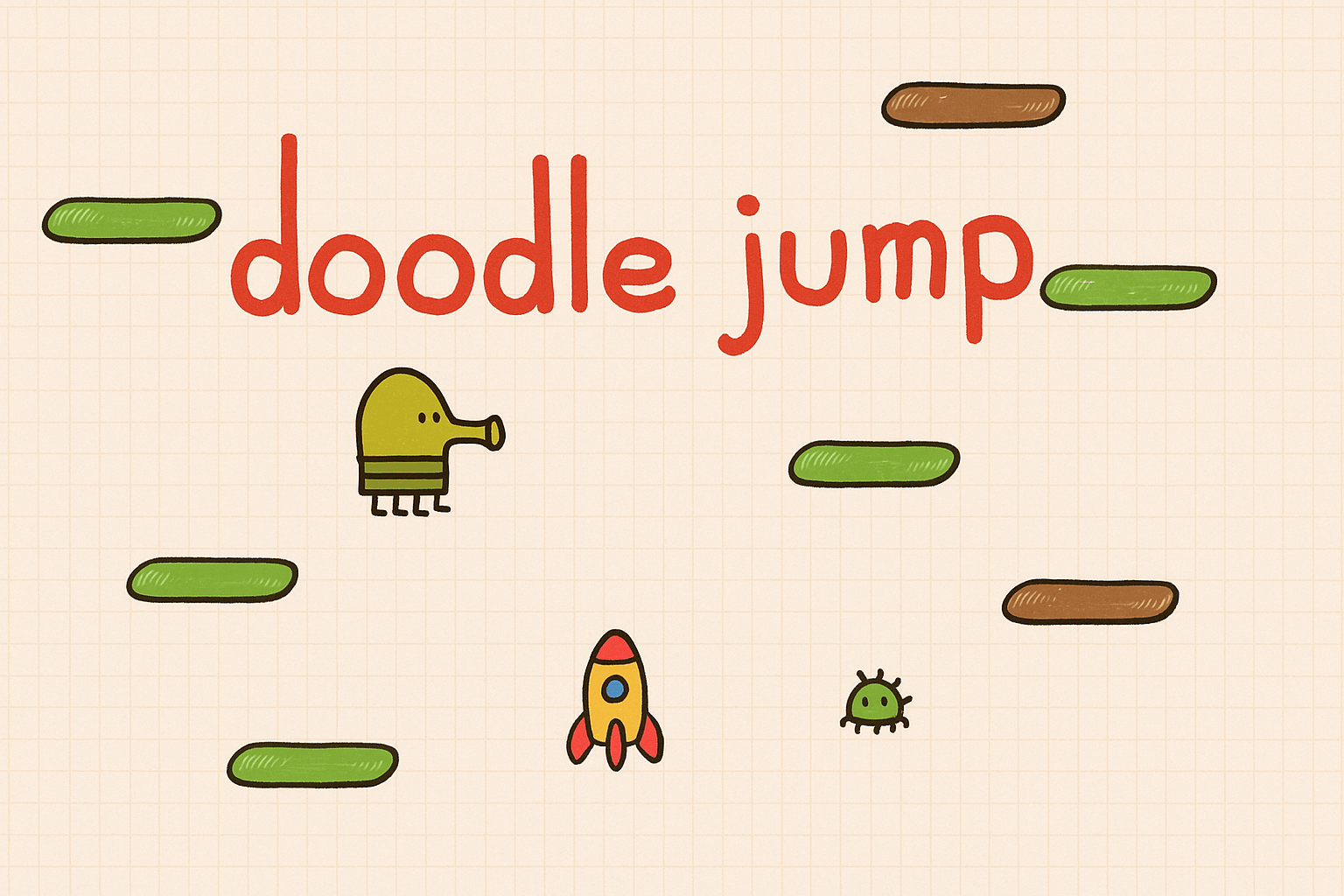
The game's premise is elegantly simple: players guide a four-legged creature named "The Doodler" up an infinite series of platforms without falling. The game screen is a vertically scrolling level that continuously moves upward, forcing the player to keep climbing. The challenge comes from navigating different types of platforms—some break, some move, and some disappear—while avoiding monsters and black holes and strategically using power-ups like springs, trampolines, and jetpacks to gain huge vertical boosts. There is no "end" to the game; the sole objective is to climb as high as possible, with your score being a direct reflection of your altitude. This simple, pure, high-score-chasing loop, combined with its responsive controls and whimsical presentation, created an irresistible "one more try" experience that has kept players hooked for well over a decade.
How to Play: The Basics of the Endless Ascent
Doodle Jump's beauty lies in its accessibility. You can understand the core concept in seconds, but true mastery requires practice and strategic thinking. Here's the fundamental gameplay loop.
The Goal: Go Up!
Your one and only objective is to guide The Doodler as high as you can. Your score is measured in height. The game ends when you miss a platform and fall to the bottom of the screen, get hit by a monster, or get sucked into a black hole.
The Gameplay Cycle: Jump, Aim, Land, Repeat
Every moment in Doodle Jump is a rapid cycle of these three actions.
- The Auto-Jump: Unlike traditional platformers, you do not have a dedicated jump button. The Doodler jumps automatically every time it lands on a platform or other solid surface. Your control is purely horizontal.
- The Aim (Movement): Your primary job is to "aim" The Doodler's landing. You control its horizontal position, guiding it left or right as it ascends from a jump to ensure it lands safely on the next platform above.
- The Landing: A successful landing on a platform triggers the next auto-jump, continuing your climb. Different platforms behave in different ways, making each landing a small strategic decision.
- Dealing with Threats: As you climb, you will encounter various monsters. You can defeat most of them by jumping on top of them, but the safest strategy is often to simply avoid them. You can also tap the screen to shoot projectiles, but this should be used sparingly.
This simple loop of Jump -> Aim -> Land is the entire game. The complexity and challenge arise from the increasing speed of the scroll, the variety of platforms, and the density of hazards as you climb higher.
Mastering the Controls: Tilt, Tap, and Precision
The controls in Doodle Jump are a masterclass in platform-specific design, offering an intuitive experience on both mobile and desktop.
Mobile Controls (iOS & Android)
- Primary Movement (Tilt): This is the classic and most popular control scheme. You tilt your physical device left or right to move The Doodler horizontally. The controls are incredibly sensitive and analog, allowing for very fine micro-adjustments. For the best experience, hold your device in a neutral, comfortable position to calibrate your "center."
- Shooting: Simply tap anywhere on the screen to make The Doodler fire a projectile straight up from its nose. This is used to defeat monsters you cannot safely jump on.
Desktop Controls (Browser Version)
- Primary Movement (Keyboard): Use the Left and Right Arrow Keys to move The Doodler. Unlike tilt controls, this is a digital input, meaning you are either moving at a fixed speed or not at all. This requires a more rhythmic, tap-based approach to positioning.
- Shooting: Press the Up Arrow Key or the Spacebar to shoot.
Regardless of the platform, the key to mastering the controls is to make small, deliberate adjustments. Wildly swinging from one side of the screen to the other is a recipe for disaster. Smooth, controlled movements are essential for lining up precise landings.
Understanding the Core Mechanics & Physics
To excel at Doodle Jump, you need to understand the fundamental physics and rules that govern its world.
- Auto-Jumping: As mentioned, The Doodler jumps automatically upon landing. The height of a standard jump is fixed. Your only goal is to guide the landing. - Screen Wrapping: The screen "wraps" around horizontally. If you move off the left edge of the screen, you will instantly reappear on the right edge, and vice-versa. This is not just a visual quirk; it is a critical strategic tool. You can use it to escape danger, get a better angle on a platform, or teleport behind an enemy. - Stomping Monsters: Jumping on top of most monsters will defeat them and give you a small upward boost, acting as an extra jump. However, some monsters are spiky or have other defenses, making this a risky maneuver. - Projectile Shooting: Tapping the screen fires a projectile. This is the only way to safely defeat certain monsters (like those you can't jump on) and UFOs. However, its use is limited, so it should be reserved for necessary situations.
Platforms, Hazards, and Monsters: Know Your Environment
The world of Doodle Jump is built from a variety of platforms and populated by numerous threats. Recognizing them instantly is key to survival.
Platform Types
- Green Platforms (Stable): These are the standard, most common platforms. They are stationary and safe to land on. - Blue Platforms (Moving Horizontal): These platforms slide left and right. You must predict their movement to land on them successfully. - Gray/Brown Platforms (Breaking): These platforms will crack and break shortly after you land on them. You can only use them for a single jump, so you must have your next move planned immediately. - White Platforms (Disappearing): These platforms vanish after a single use and do not reappear. They are often part of a one-way path upwards. - Yellow Platforms (Exploding): Similar to breaking platforms, but they have a timer and will explode. Often used in later game themes. - Springs and Trampolines: These are not platforms but attachments. Landing on one will launch you significantly higher than a normal jump.
Hazards and Monsters
- Basic Monsters: Small, multi-legged creatures that can be defeated by jumping on them. - UFOs: Flying saucers that move horizontally. They cannot be stomped and must be defeated with a projectile shot. If they get below you, they can abduct you, ending your run. - Black Holes: A deadly hazard. If you get too close, you will be sucked in, ending your run instantly. They must be avoided at all costs. - Large Monsters: In some themes, you'll encounter very large monsters that require multiple projectile shots to defeat.
Power-Ups Explained: Your Tools for a Higher Score
Scattered throughout the levels are powerful items that can give you a massive boost. Using them wisely is crucial for reaching new heights.
- Springs: A single, coiled spring attached to a platform. Landing on it gives you a super-high jump.
- Trampolines: A flat, bouncy surface that gives you a very high jump, often higher than a spring.
- Propeller Hat: Equipping this allows you to fly upwards for a short period, giving you significant height and allowing you to bypass dangerous sections. You have limited horizontal control while it's active.
- Jetpack: The most powerful vertical boost. This rocket pack straps to your back and sends you blasting upwards at incredible speed, making you invincible for its duration.
- Spring Shoes: These attach to The Doodler's feet and turn every single jump into a super-high spring jump for a limited time.
- Shield: A green bubble that surrounds you. It provides one-time protection from any single monster, saving your run from an unfortunate collision.
Scoring & Progression in an Endless World
In a game with no finish line, your score is everything.
- How Scoring Works: Your score is a direct measurement of your altitude. The higher you climb, the higher your score. The game keeps track of your personal best, which is displayed as a line you must cross on subsequent playthroughs, providing a constant target to beat. - Progression: While the game is endless, progression is felt through personal skill improvement. Beating your old high score is the primary goal. Additionally, global leaderboards allow you to compare your score against the best players in the world, providing a powerful competitive motivator.
Essential Tips & Tricks for All Skill Levels
- Look Up! Always Look Up!: The most common beginner mistake is focusing only on the platform you're about to land on. You need to train your eyes to be looking two or three platforms ahead. This gives you time to plan your route and react to moving platforms or enemies. - Master the Center: It's generally safest to stay near the center of the screen. This gives you the most time and space to react to platforms and enemies appearing on either side. - Use Screen Wrap Strategically: Don't forget you can teleport from one side of the screen to the other. This is a powerful tool for escaping a monster that has you cornered or for reaching a platform that is on the far side of the screen. - Don't Be Trigger-Happy: Shooting should be a last resort. Your primary method for dealing with monsters should be avoidance, and your secondary method should be stomping. Only shoot when a monster is blocking a critical path and cannot be safely stomped. - Control Your Power-Ups: A Jetpack can be a blessing or a curse. While it gives you huge height, it can also launch you into a black hole or a swarm of enemies when it runs out. When you grab a powerful boost, immediately start scanning the screen for a safe place to land.
Advanced Strategies: The Art of Route Planning
Reaching truly elite scores requires more than just good reflexes; it requires a strategic mind.
- The "Safe Lane" Mentality: As you climb, try to mentally identify a "safe lane"—a vertical path with a high density of stable, green platforms. When in doubt, always default to moving towards this lane. This provides a reliable fallback and prevents you from getting stranded in a sparse area. - Risk vs. Reward Assessment: You will constantly be faced with choices. Should you risk a difficult jump to grab a jetpack? Should you try to stomp a monster that's right next to a black hole? High-level players are constantly making these micro-calculations. The general rule is to prioritize survival over bonuses. A small, guaranteed height gain is always better than a risky jump for a power-up that could end your run. - Monster Baiting: You can manipulate monster movements. For example, by moving to the far left of the screen, you can often "bait" a horizontally moving monster to follow you, opening up a clear path on the right side of the screen.
Meet the Hero and Explore the Worlds
While the gameplay is king, the charming presentation adds immense personality.
- The Doodler: The game's hero is a simple, whimsical creature whose official name is "The Doodler." Its large eyes, springy legs, and expressive animations make it an endearing and iconic character. Its simple silhouette is also a key design choice, making it easy to track its position even during chaotic moments. - Visual Themes: A major feature that keeps the game fresh is its variety of unlockable themes. While the core mechanics remain the same, these themes completely change the game's visuals, platforms, and enemies. You might be jumping in the classic "Original" graph paper world, then switch to a "Space" theme with astronaut Doodlers and alien monsters, a "Jungle" theme, a "Ninja" theme, or a festive "Christmas" theme.
Similar Games for Fans of High-Score Chasing
- Jump King: For the ultimate challenge in precision vertical platforming. Infamously difficult but incredibly rewarding.
- Jetpack Joyride: A classic side-scrolling endless runner that shares the same "one more try" addictiveness and high-score focus.
- Helix Jump: A 3D vertical game where you guide a ball down a tower, requiring the same kind of timing and pattern recognition.
- Downwell: A unique vertical game where you are constantly falling, using your gun-boots to shoot enemies and slow your descent.
- Stacky Bird: A game that blends jumping and stacking mechanics, requiring precise timing to build towers of eggs to clear obstacles.
- Leap On!: An endless bouncing arcade game with a unique circular motion, focused on skill-based high-score chasing.
- Geometry Dash: A rhythm-based platformer that demands the same level of precision and pattern memorization as high-level Doodle Jump play.
- Crossy Road: An endless arcade hopper that shares Doodle Jump's charming art style and addictive, high-score-driven gameplay.
- Mega Jump: A vertical climbing game that is heavily focused on collecting coins and chaining power-ups for massive boosts.
- Icy Tower: A classic desktop vertical platformer where the goal is to climb a tower as fast as possible by performing combo jumps.
Download Doodle Jump (iOS & Android)
To get the authentic and secure Doodle Jump experience on your mobile device, it is essential to download it from the official app stores. This ensures you receive the latest updates, features, and a version free from any security risks.
- For iOS (iPhone/iPad): The official version, Doodle Jump - Insanely Good!, is available directly from the Apple App Store.
Download from the Apple App Store - For Android: You can find the official Android version on the Google Play Store.
Download from the Google Play Store
Note on Browser and Unblocked Play: Doodle Jump is widely available as an HTML5 game that can be played instantly in a web browser on PC or mobile, with no download needed. Searching for "Doodle Jump unblocked" will provide access to the game on restricted networks, such as at school or work. Always use well-known and reputable gaming websites for the safest experience.
Frequently Asked Questions (FAQs)
When did Doodle Jump come out?
The original Doodle Jump was released for iOS on April 6, 2009. It was one of the earliest and most successful games on the platform, setting the stage for the mobile gaming boom.
Is Doodle Jump an endless game?
Yes, Doodle Jump is an endless game. There is no final level or boss. The platforms are procedurally generated, meaning the level is different every time you play, and the goal is simply to climb as high as you can to set a new high score.
What is the highest score ever in Doodle Jump?
Official, verified high scores are in the tens of millions, but many unverified claims of scores in the hundreds of millions exist online. Reaching a score of over 100,000 is considered very good, and breaking 200,000 is the mark of an expert player.
Who developed Doodle Jump?
Doodle Jump was created by Lima Sky, a development studio founded by Croatian brothers Igor and Marko Pušenjak.
Can you play old Google Doodle games?
While Doodle Jump is not a Google Doodle, Google does maintain an archive of its most popular interactive Doodles. You can visit the Google Doodle Archive to play many of their classic games, like Pac-Man or the Rubik's Cube.
Does Doodle Jump need WiFi to play?
The official mobile apps downloaded from the App Store or Google Play can be played completely offline without a WiFi connection. However, browser-based versions will require an active internet connection to load and play.
Conclusion: The Timeless Joy of the Jump
Doodle Jump is a true masterpiece of arcade design. Its enduring popularity is a testament to the power of a perfectly executed core gameplay loop. By stripping away all unnecessary elements, Lima Sky created a game that is pure, challenging, and endlessly fun. The blend of simple, responsive controls, a charming hand-drawn world, and the constant, compelling drive to beat your own high score has kept it a beloved favorite for over a decade in an industry where games are often forgotten in months.
Whether you're playing for two minutes while waiting in line or for two hours in a dedicated attempt to shatter your personal best, Doodle Jump provides a perfect "one more try" experience. It is a game of skill, strategy, and perseverance, rewarding players who learn its rhythms and plan their ascent. Simple, iconic, and endlessly replayable—Doodle Jump is, and will likely always be, a true legend of the vertical arcade genre.