

 Loading...



Play Get On Top and engage in a hilarious and wildly chaotic two-player physics brawler that is as simple as it is brilliant. Developed by the master of quirky physics-based challenges, Bennett Foddy, this game pits two interconnected ragdolls in a frantic wrestling match with a single, clear objective: get on top and force your opponent’s head to hit the ground. With its minimalist design, unpredictable gameplay, and a control scheme that is easy to learn but impossible to fully master, Get On Top is the ultimate party game and a timeless classic of browser-based fun.
The game strips the fighting genre down to its bare essentials. There are no health bars, no special moves, and no complex combos. It is a pure, unadulterated test of leverage, timing, and momentum. You and your opponent are linked together, creating a wobbly, unstable mass of flailing limbs. You must push, pull, and jump to gain the dominant position and smash your rival's head into the floor to score a point. The chaotic ragdoll physics ensures that no two matches are ever the same, leading to endless moments of laughter and surprising comebacks.
Get On Top has become a legendary title in the world of "unblocked games," celebrated for its instant accessibility and its ability to create a fiercely competitive yet lighthearted atmosphere. It’s a game that proves you don’t need flashy graphics or complex systems to create a deeply engaging and endlessly replayable experience. If you are looking for a game that is a perfect blend of skill, luck, and pure, unadulterated fun, it's time to grab a friend and find out who can truly get on top.
Table of Contents
- About Get On Top: A Bennett Foddy Classic
- How to Play: Understanding the Core Wrestling Mechanic
- Game Modes and Objectives Explained in Detail
- Mastering the Deceptively Simple Controls
- Key Game Features: What Makes Get On Top a Multiplayer Gem?
- A Breakdown of the Arenas: The Minimalist Stage
- Advanced Strategies: From Flailing Novice to Wrestling Pro
- Tips & Tricks: Your Guide to Dominating the Mat
- The Social and Competitive Scene
- Similar Games to Get On Top
- Technical Aspects: Graphics, Sound, and Performance
- Development and Legacy: The Foddy Philosophy
- Is Get On Top Safe for Kids?
- Download
- Frequently Asked Questions (FAQs)
- Conclusion: Why Get On Top is an Essential Two-Player Experience
About Get On Top: A Bennett Foddy Classic
Get On Top is a 2D, two-player physics-based fighting game created by the renowned independent developer Bennett Foddy. First released in 2011, the game quickly became a cult classic, celebrated for its unique mechanics and hilarious gameplay. Foddy, famous for creating intentionally quirky and challenging games like QWOP and Getting Over It with Bennett Foddy, designed Get On Top with a similar philosophy: to create deep, emergent gameplay from a very simple set of rules and controls.
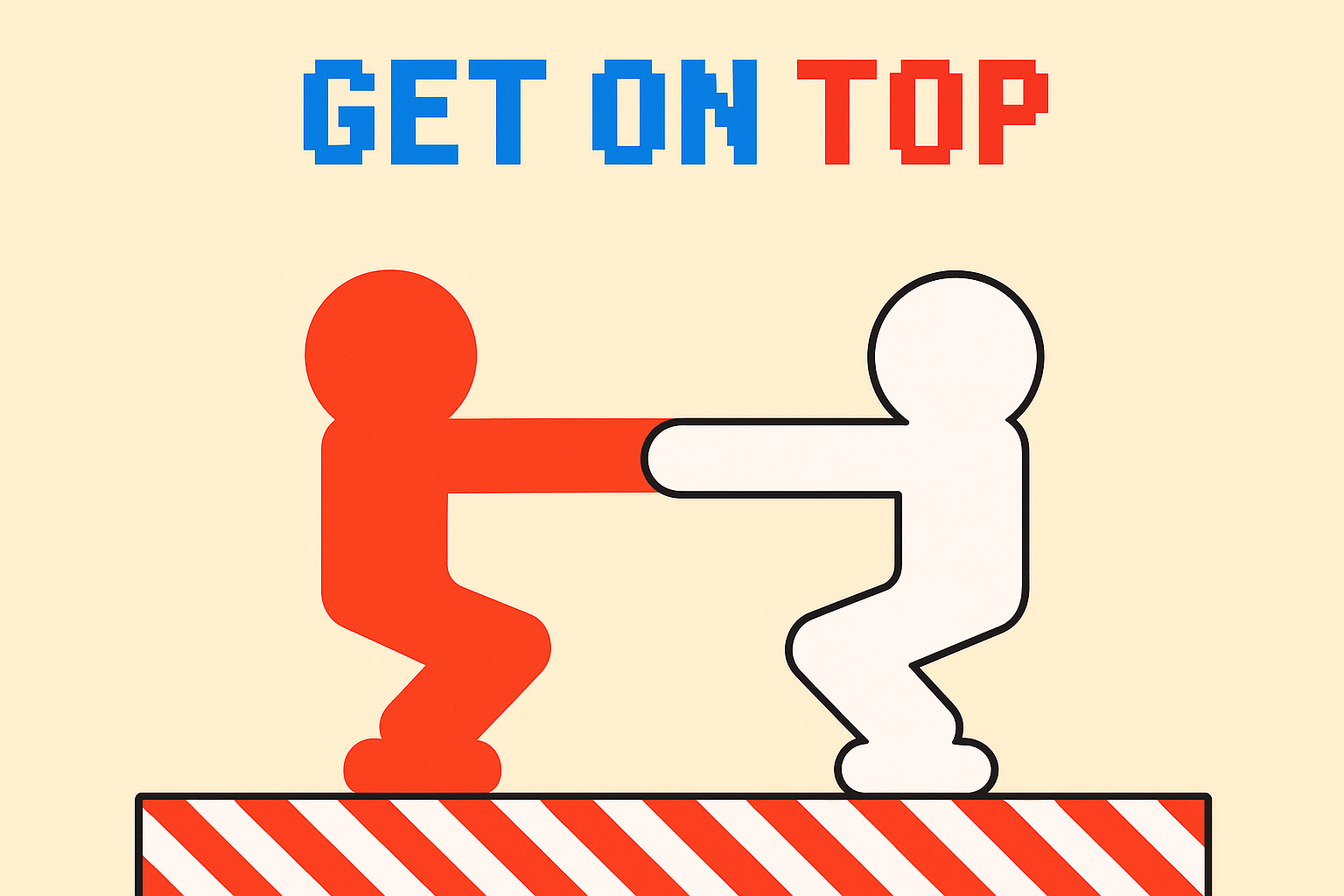
The game's premise is a brilliantly simple take on wrestling. Two players, represented by minimalist stick figures, are joined at the hands. The goal is to maneuver your character in such a way that your opponent's head touches the ground before yours does. The chaotic and often unpredictable ragdoll physics engine is the true star of the show, turning every match into a frantic, comical struggle for dominance. The first player to score eleven points wins the match.
Due to its simple, browser-based nature and its focus on local multiplayer, Get On Top became a staple of the "unblocked games" scene, enjoyed by students and friends around the world. Its lasting appeal is a testament to its perfect design, proving that a game built on a single, well-executed idea can be more engaging and memorable than many more complex titles.
- Developer: Bennett Foddy
- Publisher: Hosted on various web portals
- Release Date: 2011
- Platforms: Web Browser (HTML5, formerly Flash), Mobile (as Get On Top Touch)
- Genre: Fighting, 2-Player, Physics Game, Action, Party Game
How to Play: Understanding the Core Wrestling Mechanic
The objective in Get On Top is to win the match by being the first player to score 11 points. You score a point by causing your opponent's head to make contact with the ground. If your own head touches the ground, your opponent scores a point. This simple rule creates a high-stakes duel where both offense and defense are one and the same.
You and your opponent control two interconnected ragdolls. This connection is permanent; you cannot break away. This shared physics object is the core of the gameplay.
- The Core Mechanic - Leverage and Momentum: You do not have direct "attack" buttons. Your only actions are to push, pull, and jump. Victory is achieved by using these movements to gain a positional advantage—getting your center of gravity higher than your opponent's—and then using that leverage to slam them into the ground.
- Controlling Your Character: Your movement keys allow you to shift your character's weight and push or pull against your opponent. The jump key allows you to lift your entire connected mass off the ground, often leading to chaotic aerial flips and scrambles.
- Winning a Point: A round ends the instant one player's head touches the floor. The "winner" of the round gets one point, and both players are reset to the starting position for the next round.
- Winning the Match: The first player to accumulate 11 points is declared the winner of the entire match.
Game Modes and Objectives Explained in Detail
Get On Top is a game laser-focused on one perfect mode of play, designed to be the ultimate head-to-head challenge.
1. Two-Player Local Versus (Main Mode)
This is the heart and soul of the game and how it is meant to be played. Two players share a single keyboard and battle it out in a frantic race to 11 points. The game is a perfect catalyst for social interaction, friendly rivalry, and a whole lot of laughter. The primary objective is simply to beat your friend and earn those coveted bragging rights.
2. Single-Player vs. AI
For solo players, the game offers a single-player mode where you can compete against a surprisingly competent AI opponent. This is an excellent way to learn the game's bizarre physics, practice advanced techniques, and hone your skills before challenging a human opponent. The objective remains the same: be the first to score 11 points.
3. Unofficial Variations
The game's immense popularity has led to the creation of numerous spin-offs and similar titles. While not official modes, you can find versions online with slight variations, such as different point goals or minor tweaks to the physics, but the core experience remains universally consistent.
Mastering the Deceptively Simple Controls
The control scheme of Get On Top is a classic example of Bennett Foddy's "simple to learn, impossible to master" design philosophy. Each player has a set of three basic actions.
Player 1 Controls (Left Side):
- Move Left/Right: A / D Keys
- Jump: W Key
Player 2 Controls (Right Side):
- Move Left/Right: Left / Right Arrow Keys
- Jump: Up Arrow Key
These keys allow you to push your character's legs, effectively shifting your weight and applying force to the shared ragdoll structure. The depth of the game comes not from the controls themselves, but from understanding how these simple inputs translate into complex movements through the physics engine.
Key Game Features: What Makes Get On Top a Multiplayer Gem?
The enduring popularity of Get On Top is a result of its unique and brilliantly executed features, which create a one-of-a-kind gameplay experience.
- Hilarious Ragdoll Physics: The game's standout feature. The chaotic, unpredictable, and often comical movements of the interconnected characters ensure that no two rounds are ever the same.
- Perfectly Balanced Two-Player Gameplay: The game is one of the best examples of a local multiplayer "couch co-op" game. It's perfectly designed for two players on one keyboard.
- Simple, Accessible Controls: The three-button control scheme means anyone can start playing and understand the game in seconds, making it an ideal party game.
- Fast-Paced, Quick Rounds: With rounds often lasting just a few seconds, the action is relentless. This "just one more round" design makes the game incredibly addictive.
- Minimalist Design: The simple graphics and lack of distractions keep the focus squarely on the pure, skill-based gameplay.
A Breakdown of the Arenas: The Minimalist Stage
The "arena" in Get On Top is as minimalist as the rest of its design, providing a clean and clear stage for the chaotic action to unfold.
The Single Platform: The entire game takes place on a single, flat platform suspended in a void. There are no walls to bounce off of and no environmental hazards. The only dangers are the floor below you and the opponent connected to you.
The Visual Style: The background is a simple, solid color. The characters are stark, high-contrast stick figures. This intentional lack of visual noise is a key part of the design. It ensures that the players' positions and movements are always perfectly clear and that the focus remains entirely on the physics-based struggle between the two combatants. The arena is not a place; it is a concept—a pure, distilled space for competition.
Advanced Strategies: From Flailing Novice to Wrestling Pro
Winning consistently in Get On Top requires a deep, intuitive understanding of the game's physics and a strategic mindset that goes far beyond just pushing your opponent.
- Mastering the Pull: Pushing your opponent away is an obvious move, but pulling them is often more effective. By pulling your opponent towards you and slightly underneath you, you can use their own body as a lever to force their head into the ground.
- The Jump-Over: A key advanced technique is to use a well-timed jump to lift your character up and over your opponent. This completely reverses the leverage dynamic, putting you in the dominant "on top" position and making it easy to drive them into the floor.
- The Art of the "Kip-Up": When you are on the ground and in a bad position, don't give up. A frantic and well-timed combination of pushes and jumps can sometimes allow you to "kip-up" or kick your way back to a neutral position, snatching survival from the jaws of defeat.
- Patience and Baiting: Don't always be the aggressor. Sometimes, the best strategy is to stay stable and let your opponent make a mistake. Bait them into making a big, reckless move, and then use their own momentum against them for an easy point.
Tips & Tricks: Your Guide to Dominating the Mat
- Control the Center of Gravity: The entire game is a battle over the shared center of gravity of the two connected players. Your goal is always to keep this point underneath your own character.
- Use Small, Controlled Movements: While frantic button-mashing can be fun, the best players use small, deliberate key presses to make fine adjustments to their balance and positioning.
- Don't Be Afraid to Jump: Jumping can feel risky, but it is often the only way to break a stalemate or to initiate a powerful offensive maneuver. Learn to control your aerial flips.
- Play Defensively: Your primary goal is to keep your own head off the ground. Often, focusing on staying stable and upright is a better strategy than constantly trying to attack.
- Learn from Your Opponent: Pay attention to the moves your opponent is using to beat you. The game has a surprisingly high skill ceiling, and you can learn new techniques by observing a skilled player.
The Social and Competitive Scene
Get On Top is a social game at its very core. Its competitive scene is not found in online tournaments but in the shared, real-world experience of two people battling it out on the same keyboard. It is a game that is almost synonymous with friendly rivalries, laughter, and shouting. The game's legacy is that of a perfect "ice-breaker" and a staple of any good game night. The competition is direct, personal, and incredibly fun, making it one of the most purely social gaming experiences available.
Similar Games to Get On Top
If you love the hilarious physics-based combat of Get On Top, there are many other fantastic games that share its chaotic spirit:
- Wrestle Jump: A very similar 2D, one-button wrestling game where two players spin their arms to flip each other over and make their opponent's head hit the ground.
- Gang Beasts: A 3D multiplayer brawler where floppy, gelatinous characters fight to throw each other out of hazardous environments. It is the spiritual successor to Get On Top in many ways.
- Thumb Fighter: A simple and fun one-button game that simulates the classic schoolyard game of thumb wrestling, complete with costumed thumbs.
- QWOP: Another Bennett Foddy classic. While it's a single-player game, it features the same frustratingly hilarious, physics-based control scheme that requires immense skill to master.
- Stick Fight: The Game: A fast-paced, online multiplayer fighting game where stick figures use a variety of weapons in physics-based combat across destructible levels.
- Headsnatchers: A quirky party game where the goal is to literally pull your opponents' heads off and use them to score points in a variety of mini-games.
- Ragdoll Hit – Physics ragdoll fighting where you try to knock your opponent down.
Technical Aspects: Graphics, Sound, and Performance
Get On Top is a masterpiece of minimalist design and technical efficiency. Originally a Flash game, it has been successfully ported to HTML5 to ensure it runs on all modern browsers. The game's graphics consist of simple, high-contrast stick figures on a solid-colored background. This ultra-minimalist art style is a deliberate choice that ensures the gameplay is perfectly clear and the game is incredibly lightweight. It can run flawlessly on any hardware, from a high-end gaming PC to the most basic school Chromebook. The sound design is equally simple, with basic sound effects that provide clear feedback for the on-screen action.
Development and Legacy: The Foddy Philosophy
Get On Top was created by Bennett Foddy, a developer and philosopher whose games often explore themes of difficulty, frustration, and the joy of mastering unconventional control schemes. His design philosophy is to create unique, memorable experiences from the simplest possible inputs. Get On Top is a perfect embodiment of this philosophy. Its legacy is that of a game that has brought millions of people together for moments of pure, unadulterated fun. It is a shining example of how a simple, well-executed idea can have a more lasting impact than many big-budget titles, and it has inspired a whole generation of physics-based party games.
Is Get On Top Safe for Kids?
Yes, Get On Top is completely safe for players of all ages. The game features abstract stick figures and slapstick, cartoonish action. There is no blood, gore, or inappropriate content. The "fighting" is a comical, non-violent wrestling match. Its simple, harmless nature makes it an excellent choice for a family-friendly game and a fun way for kids to engage in some friendly competition.
Download
While Get On Top is famously a browser game, there are also mobile versions available for on-the-go play.
- Play Online: The quickest and most common way to play is directly in your web browser. No download or installation is required.
- Download on Mobile (Get On Top Touch): Official and inspired versions of the game are available on the Google Play Store and Apple App Store, often under the name "Get On Top Touch," which adapts the controls for a touchscreen interface.
- Download APK: For manual installation on Android devices, secure APK files can be found on trusted sites like APKPure.
Frequently Asked Questions (FAQs)
1. How many players can play Get On Top?
The game is designed for two players. It can be played by a single player against an AI opponent, or by two human players competing locally on the same keyboard.
2. How do you win the game?
You win a round by making your opponent's head touch the ground. You win the entire match by being the first player to win 11 rounds.
3. Can I play this game by myself?
Yes, there is a single-player mode where you can play against an AI opponent. This is a great way to practice the game's mechanics.
4. Is there an online multiplayer mode?
The original browser version of Get On Top is designed for local multiplayer on a single device. It does not have built-in online multiplayer functionality.
5. Why are the physics so chaotic and unpredictable?
The chaotic ragdoll physics are an intentional and core part of the game's design. They are what make the game so funny, unpredictable, and replayable.
6. Can I play this game on my school Chromebook?
Yes, because it is a very simple and lightweight browser game, Get On Top runs perfectly on almost any device, including Chromebooks, and is often "unblocked" on school networks.
7. Who created the game Get On Top?
The game was created by Bennett Foddy, an independent game developer famous for creating other unique and challenging physics-based games like QWOP.
8. Is it possible to get good at this game, or is it all luck?
While luck and chaos play a role, the game is highly skill-based. A skilled player who understands the physics of leverage and momentum will consistently defeat a new player.
9. Are there any sequels or other versions?
While there is no official "Get On Top 2," the game's popularity has inspired countless similar physics-based wrestling games and a mobile version called Get On Top Touch.
10. What is the best strategy to win?
There is no single "best" strategy, but a good starting point is to focus on getting your character's body above your opponent's. Use the pull-and-slam and jump-over techniques to gain a positional advantage.
Conclusion: Why Get On Top is an Essential Two-Player Experience
Get On Top is a masterwork of minimalist game design and a monumental achievement in the world of local multiplayer gaming. Bennett Foddy has crafted an experience that is pure, unadulterated fun, stripping the fighting game genre down to a single, brilliant mechanic. The game's chaotic physics, simple controls, and hilarious premise create a perfect storm of competitive and comical gameplay that has entertained millions.
It is more than just a game; it is a social event. It is a catalyst for laughter, friendly rivalry, and memorable moments. Its timeless appeal lies in its accessibility and its endless replayability. In a world of complex, online-focused games, Get On Top is a powerful reminder of the simple joy of playing a game with a friend in the same room. It is an essential title for any party, a classic of browser gaming, and a must-play for anyone who loves to laugh.